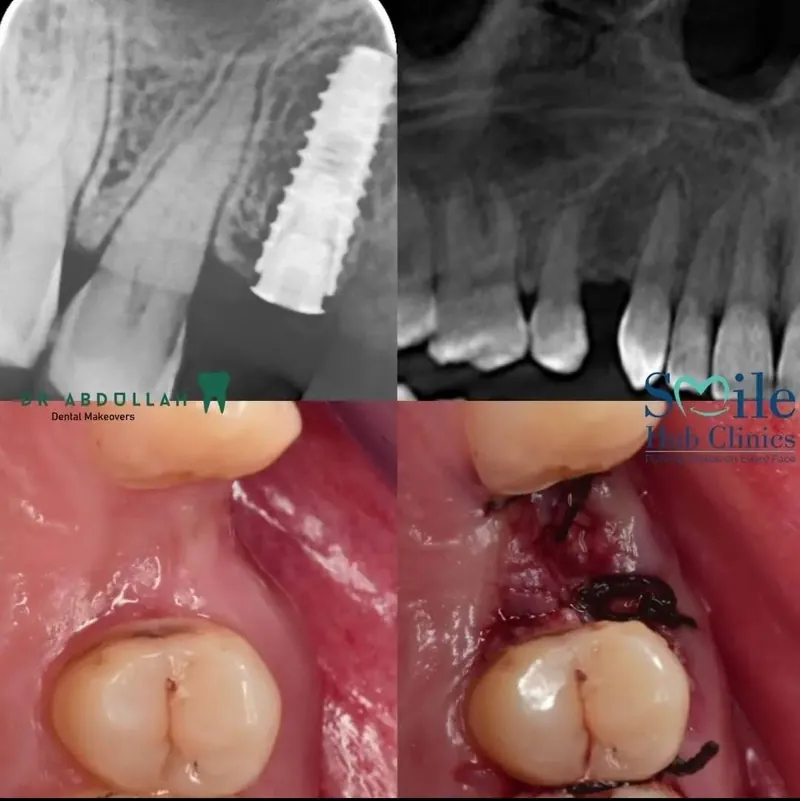
In short: Dental implants at Smile Hub Clinics, Johar Town cost PKR 85,000 (Izen, Korea) or PKR 130,000 (BioHorizons, USA) per implant with abutment, plus the crown (PKR 20,000–35,000). Every case is CBCT-planned, placed and restored in-house by an FCPS prosthodontist, with 95–98% ten-year success and a free redo if an implant fails to integrate. Consultation is free, and remote planning is available for overseas patients.
What Are Dental Implants?
A dental implant is a small titanium screw that is surgically placed into the jawbone to act as an artificial tooth root. Once the implant integrates with the bone — a process called osseointegration — a custom-made crown is attached on top, giving you a tooth that looks, feels, and functions exactly like a natural one.
Unlike dentures or bridges, implants don't rely on adjacent teeth for support. They stand independently, preserving your jawbone and maintaining your facial structure over time. This is what makes implants the gold standard in tooth replacement — not just cosmetically, but biologically.
Am I a Good Candidate?
Most adults with one or more missing teeth are suitable candidates for dental implants. A thorough assessment at Smile Hub Clinics will confirm your suitability. Here's a general guide:
✓ Good Candidates
- Adults with one or more missing teeth
- Sufficient jawbone density
- Healthy gums (no active gum disease)
- Non-smokers or those willing to quit
- Good general health
- Commitment to oral hygiene
! Requires Assessment
- Heavy smokers
- Uncontrolled diabetes
- Low bone density (may need grafting)
- Patients on blood thinners
- Severe bruxism (teeth grinding)
- Growing teenagers (under 18)
Even if you fall into the "requires assessment" category, it doesn't necessarily mean implants aren't possible. Bone grafting and other preparatory procedures can often make implant placement viable.
The Implant Process at Smile Hub Clinics
We follow a meticulous, staged approach to ensure the best possible outcome for every patient:
1
Free Consultation & Assessment
A thorough clinical examination including X-rays or CBCT scan to assess bone volume, gum health, and overall suitability. You'll receive a complete treatment plan with timeline and costs before any procedure begins.
2
Preparatory Treatment (if needed)
Any existing infections, gum disease, or bone deficiencies are addressed before implant placement. This ensures the implant has the healthiest possible environment to integrate into.
3
Implant Placement
The titanium fixture is placed into the jawbone under local anaesthesia. The procedure is typically completed in 45–60 minutes and is far more comfortable than most patients expect. A temporary restoration may be placed the same day. Every instrument is sterilised to surgical standards — see our sterilisation and infection control protocols for details.
4
Osseointegration (Healing Phase)
Over 3–6 months, the titanium implant fuses with your jawbone — a process called osseointegration. This is what gives implants their extraordinary stability and longevity. You'll have check-ups during this period.
5
Crown Placement
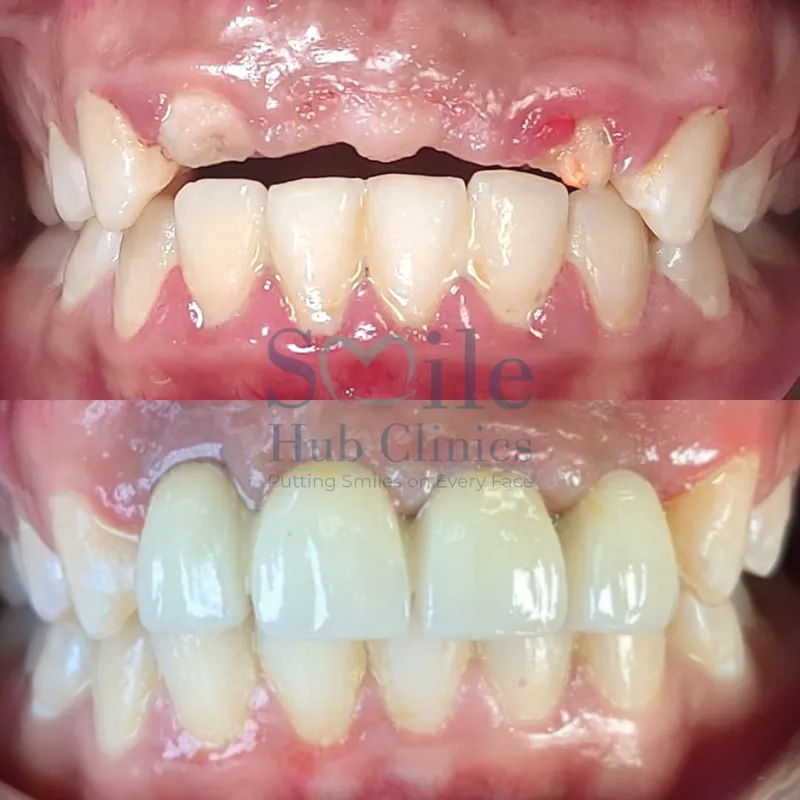
Once integration is confirmed, an abutment is placed and a custom-fabricated crown — matched precisely to the shape and shade of your natural teeth — is permanently fixed on top. The result is indistinguishable from a natural tooth.
6
Aftercare & Long-Term Maintenance
Implants require the same care as natural teeth — brushing, flossing, and regular dental check-ups. With proper maintenance, a well-placed implant can last a lifetime.
Dental Implant Cost in Lahore
We publish our pricing because you deserve to plan with real numbers, not "book a consult to find out."
PKR 85,000 / implant + abutment
Izen (Korean) — economical system
PKR 130,000 / implant + abutment
BioHorizons (USA) — premium system
The implant crown is separate: PKR 20,000 (PFM) or PKR 35,000 (zirconia) per unit. Where bone grafting is needed, it is approximately PKR 35,000 per gram, with membranes from PKR 30,000. Payment is staged — the implant is paid at placement and the crown later at restoration. Your consultation is free, and every plan comes as a clear written estimate before anything begins. Prices current as of 2026.
The Implant Systems We Use — and Our Warranty
We place BioHorizons (USA) and Izen (Korea) implants — internationally recognised systems chosen for documented long-term success and worldwide availability of parts, which matters if you ever need service away from Lahore. Our philosophy is honest: the operator matters more than the brand. A well-planned, well-placed economical implant outperforms a premium implant placed poorly.
Our warranty: if an implant fails to integrate with the bone, we redo it free of charge (barring neglect of aftercare instructions). Success rates in our hands are 95–98% over 10 years — and we tell you honestly that smoking and uncontrolled diabetes are the two biggest risks to that number.
Why Choose Smile Hub Clinics for Dental Implants?
What Sets Our Implant Service Apart
Certified Implantologist: Dr. Abdullah Karamat holds an international certification in implantology alongside his FCPS qualification — placing implants is a specialized competency, not a general skill.
Full in-house workflow: From surgical placement to crown fabrication and prosthodontic restoration, every stage is managed by a specialist under one roof — no referrals, no fragmented care.
Honest treatment planning: We don't recommend implants unless they are the right solution for you. If a simpler option is appropriate, we'll tell you.
Premium implant systems: We use internationally recognized implant brands with documented long-term success rates — not budget alternatives.
Over 5,000 patients treated in Johar Town since 2021, with a clinical environment designed for precision and patient comfort.
Your safety underpins every procedure. Read about our sterilization and patient-safety standards — including B-class autoclave sterilization and strict cross-infection control.
Dental Implants for Overseas & Visiting Patients
Implants are one of the most common reasons patients travel to us. Because Dr. Abdullah both places and restores implants in-house, your case is planned end-to-end by one FCPS prosthodontist. We begin with a remote consultation before you fly, so your plan and written estimate are ready on arrival. Depending on the case, treatment may suit a single visit with immediate loading, or be staged across two trips — we will tell you honestly which applies to you. We also frequently restore or revise implants originally placed abroad. If you are travelling for treatment, see our guide for overseas patients.
Recent Implant Cases
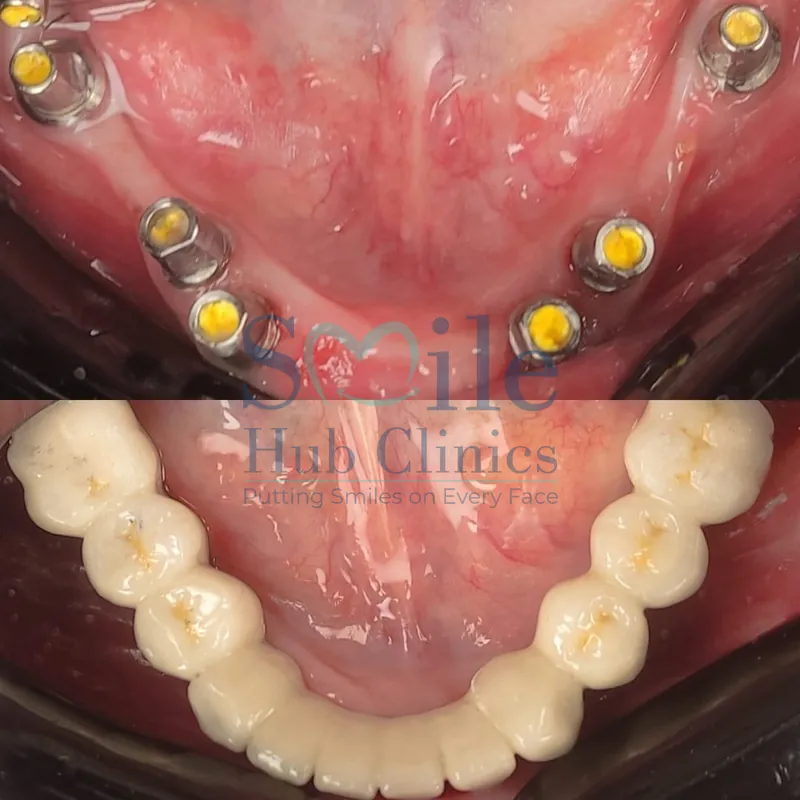
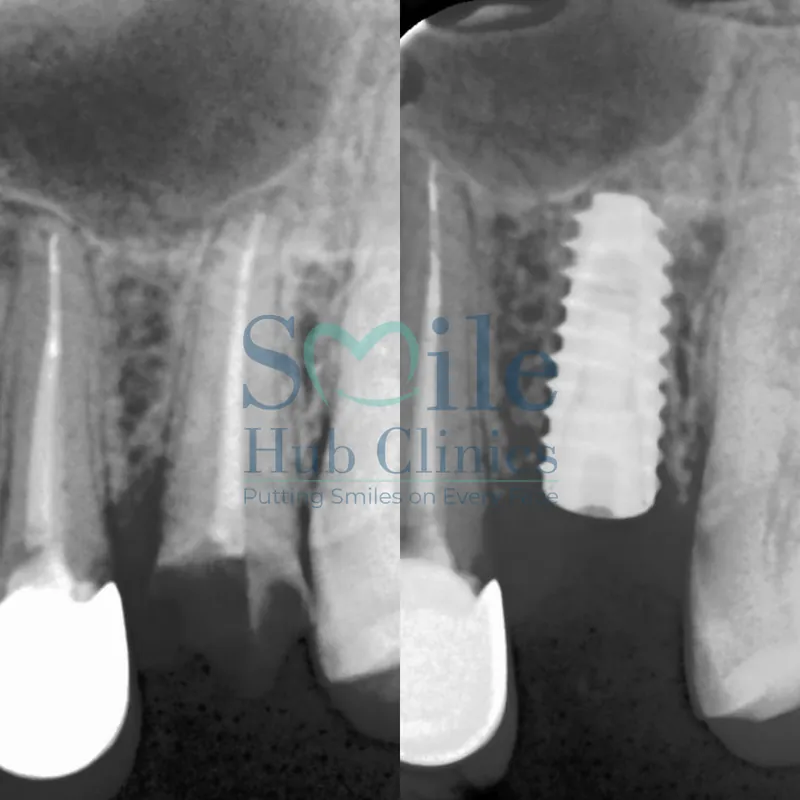
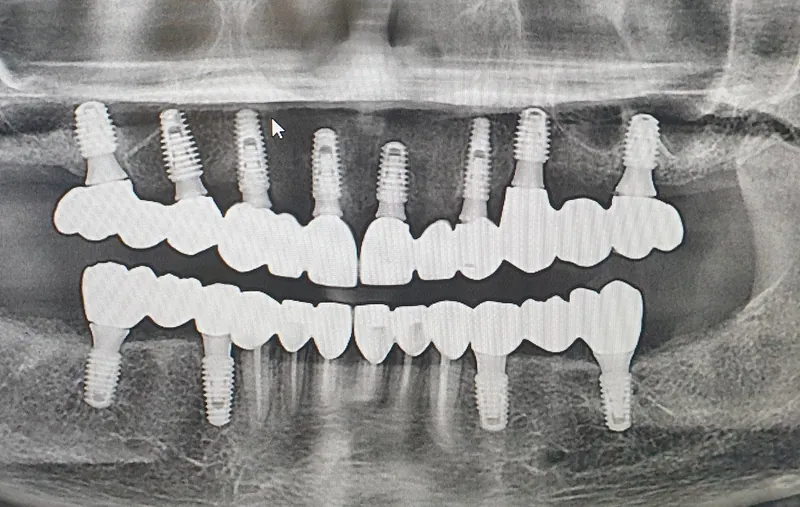
Real before-and-after implant results, planned, placed, and restored in-house.
View our full before & after gallery →
Frequently Asked Questions
How much do dental implants cost in Lahore?
A single dental implant with abutment starts from PKR 85,000 with our economical Izen system and up to PKR 130,000 with the premium BioHorizon system. The crown on top is additional — PKR 20,000 for a PFM crown or PKR 35,000 for a zirconia crown per unit (implant crowns cost a little more than crowns on natural teeth). Any bone graft (around PKR 35,000 per gram of bone used) or membrane (from PKR 30,000) is only charged if your case needs it, so you pay for exactly what you require. You receive a full itemised breakdown at your free consultation, with no hidden costs.
Are cheap dental implants safe?
Be cautious of unusually cheap implants. When the price looks too good, ask how the dentist is cutting the cost — it is almost always at the patient's expense, through a low-grade implant, a rushed protocol, or skipped diagnostics. Our prices are deliberately reasonable without compromising the implant, the planning, or the specialist placing it.
Who places and restores the implant, and why does it matter?
Dr. Abdullah Karamat, a prosthodontist, both places and restores your implant in-house. This matters because a good implant is prosthetically driven — positioned for the final tooth, not just the available bone. When one specialist plans the crown and places the implant, it fits and functions better. Many clinics place the implant then send you elsewhere for the crown; here it is one specialist and one plan.
What implant systems do you use?
We place Izen as a reliable economical option and BioHorizon as our premium option — both established implant systems. Honestly, the system matters less than who places it: success depends far more on accurate planning and surgical skill than on the brand. We help you choose the option that suits your case and budget.
Are dental implants painful?
Placement is done under local anaesthesia, so you feel pressure, not pain. Wherever possible we use flapless, guided surgery, which is gentler and heals faster. Most patients are surprised how comfortable it is. Afterwards, any discomfort is usually mild and settles with simple pain relief over 2–3 days.
What if I am anxious about the surgery?
We don't offer IV sedation, but for nervous patients we can recommend pre-operative oral sedation on a case-by-case basis, and we follow an anxiety-reduction protocol throughout the appointment. Flapless, guided surgery also keeps the procedure calmer and quicker. Tell us beforehand and we will plan around your comfort.
How long does the whole implant process take?
From placement to the final crown, most cases take 3–6 months, allowing the implant to fuse with the bone. The surgery itself takes under an hour. In selected cases we offer immediate loading — a temporary tooth on the same day — which we assess at your consultation.
Can I still get implants if I have bone loss?
Often, yes. Where bone is insufficient, a graft — with a membrane if needed — can rebuild the site before or during placement. We use CBCT 3D scanning to measure your bone precisely and plan safely, and you only pay for the graft material your case needs. This makes implants possible for many patients who were told they couldn't have them.
How long do dental implants last?
A well-placed, well-maintained implant can last 20 years or more, often a lifetime. Published studies show success rates of roughly 95–98% over ten years in healthy patients. The titanium implant itself rarely fails; the crown on top may need replacing after 10–15 years with normal wear.
What could make an implant fail, and what happens if it does?
The main risk factors are smoking and uncontrolled diabetes, which slow healing and lower success — when you follow aftercare, failure is uncommon. And if an implant fails to integrate with no patient neglect, we redo it free of cost, because we stand behind our work.
Do I have to pay for everything upfront?
No. Payment is staged — the implant cost is due at placement, and the crown or prosthesis cost when it is fitted, often months later. For genuine cases this can be relaxed further. We will set out the full plan and timing at your free consultation.
What is the downside of dental implants?
Honestly: implants cost more upfront than bridges or dentures, they involve a minor surgical step, and they take 3–6 months of healing while the implant fuses with bone. They also need the same care as natural teeth — the biggest long-term threats are gum disease around the implant, smoking, and uncontrolled diabetes. What implants are not is risky or experimental: in healthy patients, placed by an experienced clinician, success rates are 95–98% over 10 years. We'd rather you know the real trade-offs upfront than discover them later.
Do people regret dental implants?
Rarely — and when regret does happen, it almost always traces back to one of three things: poor case selection (an implant placed where it wasn't the right solution), unrealistic expectations, or choosing purely on the cheapest price and paying for it in quality. The patients who do best are the ones whose case was honestly assessed first. That's why our consultation is free and our answer is sometimes "you don't need an implant" — we solve the problem, we don't sell the solution.
What happens to dental implants after 20 years?
The implant itself — the titanium root in the bone — very commonly survives 20+ years; long-term studies show the majority still functioning decades after placement. What may need attention over that horizon is the crown on top, which can wear and typically gets replaced after 10–15 years, and the gum and bone around the implant, which need the same hygiene care as natural teeth. Keep the gums healthy and attend reviews, and an implant is realistically a decades-long solution.
Which is worse — tooth extraction or implant?
Counterintuitively, most patients report that implant placement is more comfortable than the extraction was. An extraction involves loosening a tooth from inflamed, often infected tissue; implant placement is a precise, planned procedure in prepared bone under local anaesthesia — many patients describe feeling pressure but no pain, with only mild soreness for a day or two afterwards.
Which is healthier — a root canal or an implant?
If your natural tooth can be saved, saving it is almost always the better option — a well-done root canal preserves your own root, bone, and bite. An implant is the best solution for a tooth that cannot be saved, not a replacement for one that can. Coming from a clinic that places implants every week, take that honestly: we routinely advise root canal treatment over extraction-and-implant when the tooth is savable. Our FCPS endodontist handles exactly these cases — see our
root canal treatment page.
What are the do's and don'ts after a tooth implant?
For the first 48 hours: do use cold compresses, take the prescribed medication, eat soft cool foods, and rest. Don't smoke (the single biggest healing risk), don't rinse vigorously or spit forcefully, don't disturb the site with your tongue or fingers, and avoid hot drinks and strenuous exercise. After that, gentle salt-water rinses and meticulous but careful hygiene. You'll get written aftercare instructions from us — following them is a genuine part of our warranty terms.
Is a dental implant major surgery? How long does it take?
No — a routine single implant is minor oral surgery, typically 30–60 minutes under local anaesthesia, and you go home the same day. We plan every case on a CBCT scan and prefer flapless, guided placement where the case allows, which means smaller surgical steps, less swelling, and faster healing. Complex cases (multiple implants, grafting) take longer and are planned accordingly — you'll know your exact plan before anything begins.
Which is better — a bridge or an implant?
For a single missing tooth with healthy neighbours, an implant is usually better: a bridge requires grinding down the two adjacent teeth as anchors, sacrificing healthy tooth structure, while an implant stands alone and preserves them. A bridge becomes the sensible choice when the neighbouring teeth already need crowns anyway, or when an implant site is compromised. Case selection decides — see our
crowns & bridges page for when a bridge genuinely wins.
Can dental implants get cavities?
No — titanium and ceramic cannot decay. But the gum and bone around an implant can become inflamed and infected (peri-implantitis), which is the most common long-term implant problem and behaves like gum disease. That is why implants need the same brushing, flossing, and regular reviews as natural teeth. The implant can't get a cavity; its foundations still need care.
What is the cost of full-mouth implants?
Full-mouth solutions range from implant-retained overdentures to full-arch fixed reconstruction, and the cost depends entirely on the number of implants, the design, and your bone — so we don't quote a single figure. Every full-mouth case gets a free assessment and a written, staged plan with exact costs before anything begins. See our
full-mouth rehabilitation page for how these cases are planned.
Can a dental implant be replaced if it fails?
Yes — a failed implant is not a one-shot chance. It can be removed, the site allowed to heal (with grafting if needed), and a new implant placed, usually with success. At Smile Hub, if an implant fails to integrate, we redo it free of charge under our warranty (barring neglect of aftercare). Failure is uncommon at 95–98% ten-year success — and it is recoverable.
Do you place basal implants?
No — never. Basal implants are marketed aggressively in Pakistan with promises of "no bone graft" and "teeth in 3 days," but mainstream implantology has largely moved away from them: the evidence base is weak, and when they fail, they fail catastrophically — with bone destruction that makes re-treatment far harder. We explain our full position, and how to evaluate implant marketing claims, in our honest guide:
How to Choose a Dental Implant in Pakistan.
What about mini dental implants?
Mini implants have a legitimate but narrow role — most commonly stabilising a loose lower denture where bone width is limited. We use them on a case-by-case basis with proper loading protocols. What we don't do is use minis as a cheap substitute for a standard implant where a standard implant is indicated — the long-term performance isn't equivalent, and you deserve to know the difference before choosing on price.